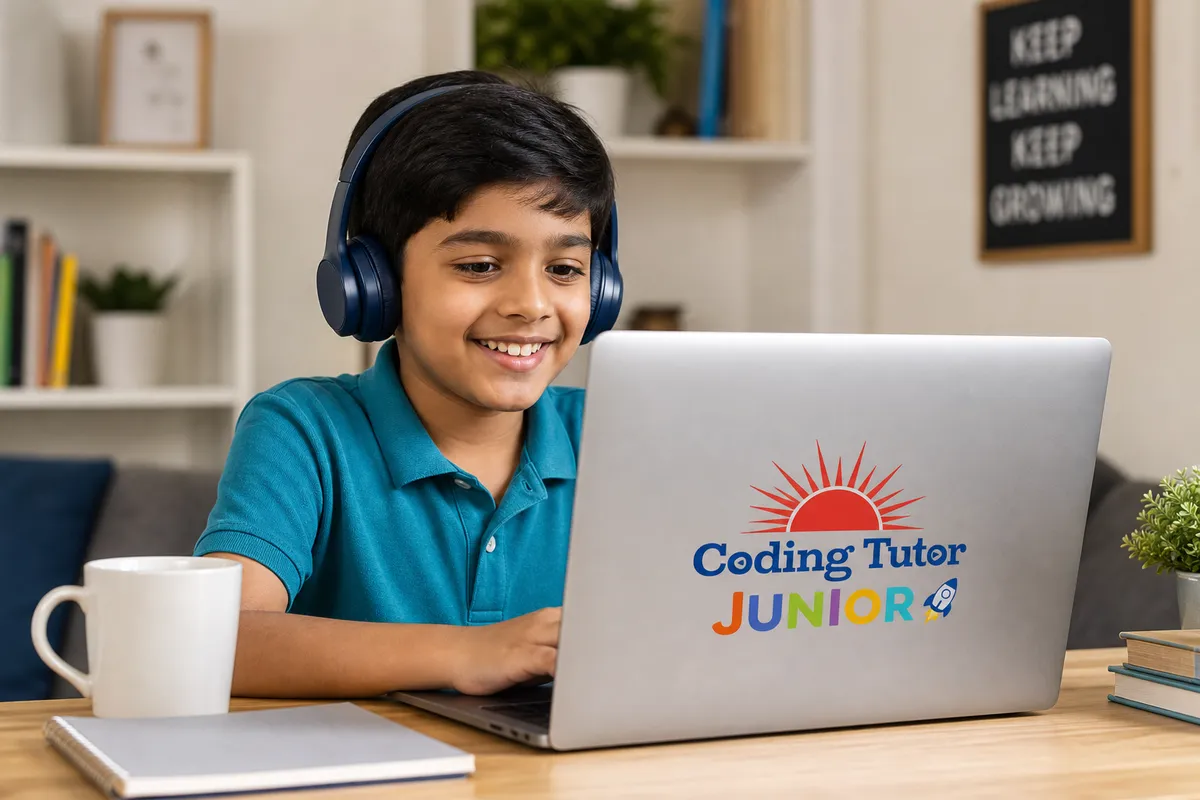
One of the first decisions parents make is simple to ask and hard to answer: Should my child learn coding online or in person?
At Coding Tutor Junior, we offer both — because the “best” format depends on your child’s energy, your schedule, and how they focus. What should not change is the learning quality: clear mentoring, grade-appropriate curriculum, and real projects.
Use this guide to choose with confidence.
What both formats should deliver
Whether your child joins from home or in a classroom, a strong program still needs:
- Live mentoring — not only pre-recorded videos.
- Age-right pacing for Grades 5–10.
- Project checkpoints every few weeks.
- Parent visibility into what was built, not just attendance.
- Responsible AI learning — understanding tools, not outsourcing thinking.
If a class can’t show those, the delivery format won’t fix it.
When online classes work especially well
Online learning is often a great fit when:
- Travel time would eat into study and rest.
- Your child is comfortable on a laptop with a quiet setup.
- You want flexible scheduling around school and activities.
- Mentors can still screen-share, debug live, and keep the session interactive.
Online succeeds when it feels like a real class — camera on, questions welcomed, projects reviewed — not a passive stream.
When in-person classes help more
In-person can be better when your child:
- Focuses better with peers in the same room.
- Thrives on hands-on collaboration and classroom energy.
- Needs clearer separation between “home time” and “learning time.”
- Enjoys showing work face-to-face to mentors and classmates.
The social spark of a room can turn coding from “another screen” into a shared club-like habit.
A practical decision checklist
Ask yourself these five questions:
- Does my child stay engaged for 45–60 minutes on a video call?
- Do we have a reliable device, internet, and a quiet corner?
- Would travel make consistency harder than the class itself?
- Does my child learn faster with peer energy nearby?
- Can the program show sample student projects before we enroll?
If answers lean toward focus-at-home and schedule flexibility, start online. If answers lean toward peer energy and structured space, start in person.
The real success metric: projects completed
Parents sometimes compare class length or brand names. A clearer metric is:
- How many working projects does my child finish in a term?
- Can they explain what they built in their own words?
- Are they moving from copy-along steps to independent problem-solving?
That progress shows up in both online and in-person tracks when teaching is project-based — the approach we use across Python with AI, Java with AI, and related programs.
Not sure? Try a demo first
The fastest way to decide is to watch your child in a session. Book a free demo class, see how they respond to the mentor and the project, then choose the format that keeps them coming back.
You can also read more about our approach on the Our Story page.
Coding Tutor Junior — online or in person, the goal is the same: kids who can think, build, and explain.